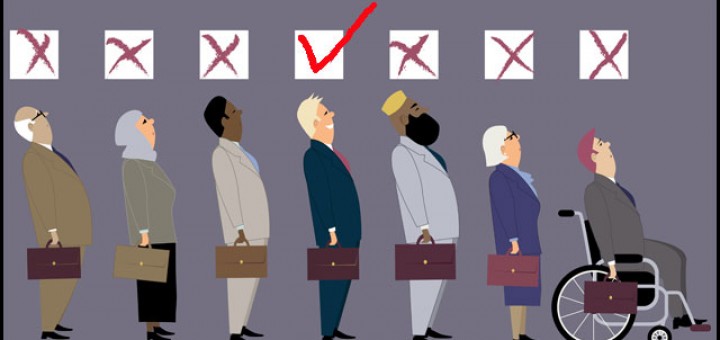
The article “Workplace discrimination is illegal. But our data shows it’s a huge problem” addresses two major workplace discrimination cases in Alabama and New York. This blog will argue that there are flaws in the systems in place to address workplace discrimination in both the U.S and Canada. In Alabama, black employees at the Austal Navy shipyard experienced a pattern of racist messages from writings of slurs on the restroom stalls to nooses hanging from the ceiling (Yerardi and Maryam, 2019). In addition, the supervisor of the shipyard would call black employees “monkeys” over walkie talkie. Ron Law and 18 of his co-workers went to the U.S Equal Opportunity Commission (EOC) to end the discrimination and receive compensation (Yerardi and Maryam, 2019). The EOC is used to investigate workers complaints of job discrimination. However, even with the EOC many people give up on receiving compensation after not hearing from them after a year. The EOC receives approximately more than 100,000 cases but only 18 per cent of workers receive money or change in work conditions (Yerardi and Maryam, 2019). It is important to note, that there are other groups of workers alleging discrimination on the basis of age, gender, disability. However, studies show that race claims are the most commonly filed and the least likely to receive compensation (Yerardi and Maryam, 2019). To add on, these cases usually are closed rather quickly based on insufficient evidence. This is because the main problem with discrimination in the workplace in present day is that it often isn’t outright slurs but usually a difference in pay/benefits compared to their white counterparts. This is shown through the UPS workers in New York. Management would make up stories to make it look like the victim was in the wrong and it was justified (Yerardi and Maryam, 2019). For example, Jason Jessup described he was regularly written up for failure to take lunch, not wearing UPS socks, and unsafe turns (Yerardi and Maryam, 2019). In other words, black drivers were being punished for transgressions that white drivers got away with. In addition, the EOC places the burden on the employee to prove this discrimination is happening. Moreover, workplace discrimination and wrongful termination have long-term impacts on mental health. Three years after he was fired Jason Jessup mentions, “I can’t afford a therapist and I’m depressed and stressed” (Yerardi and Maryam, 2019). Next, some workers fear filing a complaint against discrimination because of fear of losing their job.

Even though the article focused on the flaws with the American commission for workplace discrimination, Canada’s system also has flaws. Studies found that “visible minorities in Canada were 11 per cent likely than those in the U.S” to be discriminated against during the hiring process (Collie, 2019). In fact, Black Canadians are often associated with low level jobs (Collie, 2019). In the article by Global News Ng states, “Employment Equity Act (EEA) is outdated and limited in scope” which leads to these discriminatory hiring processes (Collie, 2019). This is because the EEA only protects those who are already employed and neglecting those discriminated in the hiring process. As well, the EEA can only cover government regulated industries such as financial services, telecommunications, and transportation (Collie, 2019). Which Ng explains “is a small portion of the Canadian workforce” (Collie, 2019). In addition, companies are reluctant to diversify unless they see a monetary return from doing this (Collie, 2019).
Overall, even though the ECC has the right intentions of standing up for worker’s rights but the flaws prevent it from actually being effective. This is shown through, the lack of success in worker’s receiving compensation, the context of what is considered insufficient evidence, and the burden placed on the employees. From this, workers are hesitant to report workplace discrimination, and some end up suffering from mental health issues. Moreover, from a present-day Canadian perspective the EEA has flaws as well that lead to discriminatory hiring processes. Both the ECC and EEA flaws prove that the laws/commissions need to be revisited and that despite efforts against workplace discrimination it still continues on to present day.
References:
Collie, Meghan. “Canada Has a Discrimination Problem When It Comes to Hiring – Here’s Why.” Global News, Global News, 25 June 2019, globalnews.ca/news/5424465/discriminatory-hiring-practices-canada/.
Jameel, Maryam, and Joe Yerardi. “Workplace Discrimination Is Illegal. But Our Data Shows It’s Still a Huge Problem.” Vox, Vox, 28 Feb. 2019, www.vox.com/policy-and-politics/2019/2/28/18241973/workplace-discrimination-cpi-investigation-eeoc.
 Gelasia's workplace
Hi Gelasia,
I really enjoyed your article and the examples you provided. It is very surprising that visible minorities in Canada are 11% more likely to get discriminated against during a hiring process despite the fact that Canada is a melting pot of diversity.
While we have been mostly successful in condemning overt employment discrimination based on race and ethnicity, studies have shown, that this leads to the increase in covert behaviours or the indirect type which was discussed in Module 6 (Lennartz, Proost, & Brebels, 2019). This trade-off certainly is quite alarming. It is also concerning that you mentioned that 18,000 cases receive compensation out of the 1000,000 cases filed to the EOC. While this seems like a disappointing figure, I am curious regarding how much of these claims are legitimate? Do you think that there are cases that were systematically orchestrated so employees can file a claim?
Finally, I do agree with the downward spiral that this kind of discrimination triggers such as mental health implications. The difficult part, however, is proving that race and ethnicity were a “defining factor” for any employment decision particularly in a hiring process. Do you have any inputs regarding how the ECC and EEA can solve this?
This is a sad reality that we face. I don’t think we will be able to completely eradicate discrimination in the workplace anytime soon, but the current band-aid is learning how to navigate through this.
Reference:
Lennartz, C, Proost, K, Brebels, L. Decreasing overt discrimination increases covert discrimination: Adverse effects of equal opportunities policies. Int J Select Assess. 2019; 27: 129– 138. https://doi.org/10.1111/ijsa.12244
LikeLike
Hi Christian,
I definitely agree that the statistic on cases is very shocking and I applaud your questioning of the legitimacy of all those of claims. I would assume that a small number could necessarily be legit but at the same time considering it is a hard task enough to come forward to file these claims and the risk of losing their job I doubt they are fake. Moreover, I definitely agree on the difficulty of proving race is the main factor for a certain worker being discriminated or mistreated. In terms of input for the EEA, more companies should implement diversity and inclusion practices making it more legal rather than voluntary. As well, I suggest both the ECC and EEA or Canadian Human Rights Commission has more checks and balances. Such as hiring more people in the investigation processes of claims, having a higher number of claims investigated, and working on responding to claims faster rather than waiting 3 years to respond to one. However, I know these suggestions aren’t simple and will take some time to implement and implement them effectively. As well as the resources and funding for these suggestions.
Best,
Gelasia
LikeLike
Hi Gelasia,
It is worth thinking about discrimination in the workplace since it has been impacting many people’s life. And I enjoyed reading your post about it. It is a sad fact that neither EOC in the US nor EEA in Canada is doing a thorough and effective job in helping people who are facing or once faced discrimination in their workplace. I am also shocked by the fact that minorities in Canada are 11% more likely to be discriminated against than those in the US during the hiring process.
However, as you mentioned, there are other types of discrimination such as age and sex discrimination. How does a person tell if he/she is being discriminated during the hiring process? It can be hard to know since “employers are usually very vague when providing interview feedback and will say something like, ‘Sorry, we chose to move forward with someone who we felt was a slightly better fit,’ when they reject you.” (Landrum, 2017). What are the ways for them to collect evidence? Furthermore, I am curious about how EEA decides if these related claims are convincible or not.
Thank you for your great post!
Liang
References:
Landrum, S., “How to Know If You’re Being Discriminated Against in the Hiring Process” CareerSidekick, 2017. https://careersidekick.com/discrimination-in-your-job-search/
LikeLike
Hello,
Thank you for your comment. I definitely agree that it is hard to prove discrimination in the hiring process especially with vague language such as “someone was a better fit”. In the global news article on the Canadian hiring process discrimination it was tested by an experiment where they gave out 200,000 fake applications where race was disclosed and visible minorities were less likely to get a callback compared to their white counterpart. As well, the article mentions that if more companies were forced into EEA diversity and inclusion practices there would be less discrimination at these companies. In terms of claims of workplace discrimination, people would file to the Canadian Human Rights Commission. The commission is very vague on what makes claims convincible but an investigation is done and the employee is responsible for collecting evidence for example, text messages or emails from the supervisors that contain ignorant comments or pictures of certain acts. In the Vox article, it was mentioned looking at the rate in which black people received punishment and how their white counterparts did not receive punishment for the same thing. Which would prove there is a clear discrimination present.
Best,
Gelasia
LikeLike