Hello, my name is Gelasia, I’m a second year DEVS student who enjoys reading, dancing, and Netflix. One of my favorite shows to watch on Netflix being the Office. I mention this because the office has sparked my interest in workplace regulations, even though it mainly parodies them. My first job was last year as a Starbucks Barista at Canada’s Wonderland. As a result, I learned the struggles of being a barista while also having to learn the specific protocols of working at an amusement park. Similar to professor Weinberg we had a strict dress code that involved every Starbucks employee to wear all black including the shoes and have natural hair colours (no bright ones allowed). Working at Starbucks helped me learn both teamwork in the context of a workplace and how to provide customer service effectively. This can be seen when a customer presents a problem, to which the worker must first apologize, ask the customer to explain the scenario, provide a solution, then apologize again for the inconvenience. In terms of this course, I’m most interested in learning more about the health, safety and injury in the Canadian Workplace. Mainly because during my time at Starbucks I did sustain a workplace injury after a co-worker spilled hot tea on me. Wonderland policy was that I was immediately sent to first aid and filled out an accident form. Since the burn healed pretty quickly, I was able to still work by the end of the week and did not have to follow up with another doctor. By the end of the week however I had to be questioned about possible treatment and work leave. Even though I sustained a minor injury, I would love to learn what protocols and preventions are in place when it comes to more serious work injuries being sustained. As well, I took Law 201 last semester and the section on workplace law has spurred my interest in the human rights unit that we will also be studying in this course this semester. With this in mind, the knowledge of workplace policies from this course will hopefully help me at my next future jobs in terms of knowing rights and regulations. As well as maybe acquiring knowledge that could help with a job in Human Relations.
My First Blog Post
Be yourself; Everyone else is already taken.
— Oscar Wilde.
This is the first post on my new blog. I’m just getting this new blog going, so stay tuned for more. Subscribe below to get notified when I post new updates.
Addressing workplace discrimination is still a work in progress…(EMPR 240: Round 2)
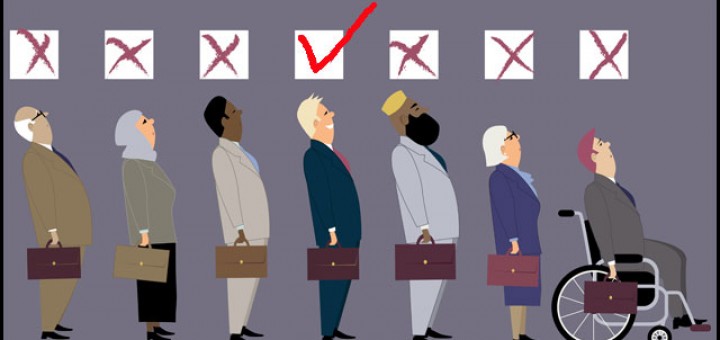
The article “Workplace discrimination is illegal. But our data shows it’s a huge problem” addresses two major workplace discrimination cases in Alabama and New York. This blog will argue that there are flaws in the systems in place to address workplace discrimination in both the U.S and Canada. In Alabama, black employees at the Austal Navy shipyard experienced a pattern of racist messages from writings of slurs on the restroom stalls to nooses hanging from the ceiling (Yerardi and Maryam, 2019). In addition, the supervisor of the shipyard would call black employees “monkeys” over walkie talkie. Ron Law and 18 of his co-workers went to the U.S Equal Opportunity Commission (EOC) to end the discrimination and receive compensation (Yerardi and Maryam, 2019). The EOC is used to investigate workers complaints of job discrimination. However, even with the EOC many people give up on receiving compensation after not hearing from them after a year. The EOC receives approximately more than 100,000 cases but only 18 per cent of workers receive money or change in work conditions (Yerardi and Maryam, 2019). It is important to note, that there are other groups of workers alleging discrimination on the basis of age, gender, disability. However, studies show that race claims are the most commonly filed and the least likely to receive compensation (Yerardi and Maryam, 2019). To add on, these cases usually are closed rather quickly based on insufficient evidence. This is because the main problem with discrimination in the workplace in present day is that it often isn’t outright slurs but usually a difference in pay/benefits compared to their white counterparts. This is shown through the UPS workers in New York. Management would make up stories to make it look like the victim was in the wrong and it was justified (Yerardi and Maryam, 2019). For example, Jason Jessup described he was regularly written up for failure to take lunch, not wearing UPS socks, and unsafe turns (Yerardi and Maryam, 2019). In other words, black drivers were being punished for transgressions that white drivers got away with. In addition, the EOC places the burden on the employee to prove this discrimination is happening. Moreover, workplace discrimination and wrongful termination have long-term impacts on mental health. Three years after he was fired Jason Jessup mentions, “I can’t afford a therapist and I’m depressed and stressed” (Yerardi and Maryam, 2019). Next, some workers fear filing a complaint against discrimination because of fear of losing their job.

Even though the article focused on the flaws with the American commission for workplace discrimination, Canada’s system also has flaws. Studies found that “visible minorities in Canada were 11 per cent likely than those in the U.S” to be discriminated against during the hiring process (Collie, 2019). In fact, Black Canadians are often associated with low level jobs (Collie, 2019). In the article by Global News Ng states, “Employment Equity Act (EEA) is outdated and limited in scope” which leads to these discriminatory hiring processes (Collie, 2019). This is because the EEA only protects those who are already employed and neglecting those discriminated in the hiring process. As well, the EEA can only cover government regulated industries such as financial services, telecommunications, and transportation (Collie, 2019). Which Ng explains “is a small portion of the Canadian workforce” (Collie, 2019). In addition, companies are reluctant to diversify unless they see a monetary return from doing this (Collie, 2019).
Overall, even though the ECC has the right intentions of standing up for worker’s rights but the flaws prevent it from actually being effective. This is shown through, the lack of success in worker’s receiving compensation, the context of what is considered insufficient evidence, and the burden placed on the employees. From this, workers are hesitant to report workplace discrimination, and some end up suffering from mental health issues. Moreover, from a present-day Canadian perspective the EEA has flaws as well that lead to discriminatory hiring processes. Both the ECC and EEA flaws prove that the laws/commissions need to be revisited and that despite efforts against workplace discrimination it still continues on to present day.
References:
Collie, Meghan. “Canada Has a Discrimination Problem When It Comes to Hiring – Here’s Why.” Global News, Global News, 25 June 2019, globalnews.ca/news/5424465/discriminatory-hiring-practices-canada/.
Jameel, Maryam, and Joe Yerardi. “Workplace Discrimination Is Illegal. But Our Data Shows It’s Still a Huge Problem.” Vox, Vox, 28 Feb. 2019, www.vox.com/policy-and-politics/2019/2/28/18241973/workplace-discrimination-cpi-investigation-eeoc.
Minimum Wage and it’s impacts on Mental Health (EMPR 240)
In this blog, I will be arguing and analyzing how increasing minimum wage can reduce suicide rates among the working class. The Global News article by Leslie Young details a case study showing the connection between increasing minimum wage and the decrease in suicide rates. The main argument being that “for every dollar added to the minimum wage suicide rates among people with high school education or less dropped by 3.4 to 5.9 per cent” (Young, 2020). In other words, increasing minimum wage and making it more of a living wage allows for people’s mental health to improve. As a result of their mental health improving, suicide rates decrease. Furthermore, Young mentions a quote from Evelyn Forget (Health Sciences Professor) who explains the lower someone’s income is the more likely they will suffer from anxiety and other mental health disorders (Young, 2020). In addition, it is also important to outline that this impacts people with a high school education or less because they are shown to be more impacted by the effects of minimum wage. This is because those with a college degree are less likely to work at lower wage jobs (Young, 2020). Moreover, research estimates that just a dollar increase in minimum wage could have prevented 27,550 suicides (Young, 2020). In particular with our recent minimum wage increases Canada’s suicide rate has decreased from 11.7 to 10.3 per 100,000 population (Young, 2020). Next, the case study also showed how increasing minimum wage is shown to provide a protective effect during times of unemployment. As well, Canada has more social policies that protect the unemployed compared to the U.S (Young, 2020). As well, for those who are employed cases have shown to they’re known to have greater job satisfaction which improves mental health (Leigh and Du, 2018). Since the workers are being paid more, they are more likely to be content with their job. When someone is content in their work life it can improve their mental health. This is because they aren’t suffering from job stress and the anxiety that comes from it. Job satisfaction benefits not only the workers but the employers. If an employee is satisfied with their job, they will most likely work harder and show better productivity. As well, hypothetically with the minimum wage increase it provides an economic incentive to work harder (Leigh and Du, 2018). Which some could argue could also damage mental health because of people pushing themselves to work too hard. However, there are policies in place that prevent working too many hours and are compensated for working overtime.
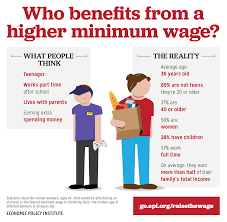
*Image above: Perception that minimum wage increase only benefits teenagers when in reality it improves the life of the working class that has kids and a family and work full time*
Lastly, by increasing the minimum wage by a couple dollars each period has been shown to not cause a significant raise in business costs (CMHA). Which many employers get concerned about when minimum wage skyrockets. When done efficiently minimum wage raise allows for closing the poverty gap and bettering mental health (CMHA). To conclude, with these case studies in mind politicians should consider both the mental health and economic effects when increasing minimum wage. The fact that all it takes is a raise in the minimum wage to decrease suicide rates and empower the working class should be proof politicians should continue to make it more livable wage. As argued throughout this post, there are many benefits mentally to the working class. However, this could also improve productivity which helps the employers with minimum business costs. Especially, in today’s society the prevention of suicide and the awareness of mental health are important. So, to have a policy in place that could decrease and prevent this issue should be valued and considered.
References:
Leigh, J. Paul. “Effects Of Minimum Wages On Population Health.” Effects Of Minimum Wages On Population Health | Health Affairs, 4 Oct. 2018, www.healthaffairs.org/do/10.1377/hpb20180622.107025/full/.
“Policy Papers on Equity.” CMHA Ontario, ontario.cmha.ca/documents/a-cmha-ontario-submission-to-the-minimum-wage-advisory-panel-a-healthy-approach-to-earned-income/.
Young, Leslie. “Increasing the Minimum Wage Can Reduce Suicide Rates, Study Finds.” Global News, Global News, 7 Jan. 2020, globalnews.ca/news/6377954/minimum-wage-suicide-rate/.
Introduce Yourself (Example Post)
This is an example post, originally published as part of Blogging University. Enroll in one of our ten programs, and start your blog right.
You’re going to publish a post today. Don’t worry about how your blog looks. Don’t worry if you haven’t given it a name yet, or you’re feeling overwhelmed. Just click the “New Post” button, and tell us why you’re here.
Why do this?
- Because it gives new readers context. What are you about? Why should they read your blog?
- Because it will help you focus you own ideas about your blog and what you’d like to do with it.
The post can be short or long, a personal intro to your life or a bloggy mission statement, a manifesto for the future or a simple outline of your the types of things you hope to publish.
To help you get started, here are a few questions:
- Why are you blogging publicly, rather than keeping a personal journal?
- What topics do you think you’ll write about?
- Who would you love to connect with via your blog?
- If you blog successfully throughout the next year, what would you hope to have accomplished?
You’re not locked into any of this; one of the wonderful things about blogs is how they constantly evolve as we learn, grow, and interact with one another — but it’s good to know where and why you started, and articulating your goals may just give you a few other post ideas.
Can’t think how to get started? Just write the first thing that pops into your head. Anne Lamott, author of a book on writing we love, says that you need to give yourself permission to write a “crappy first draft”. Anne makes a great point — just start writing, and worry about editing it later.
When you’re ready to publish, give your post three to five tags that describe your blog’s focus — writing, photography, fiction, parenting, food, cars, movies, sports, whatever. These tags will help others who care about your topics find you in the Reader. Make sure one of the tags is “zerotohero,” so other new bloggers can find you, too.
 Gelasia's workplace