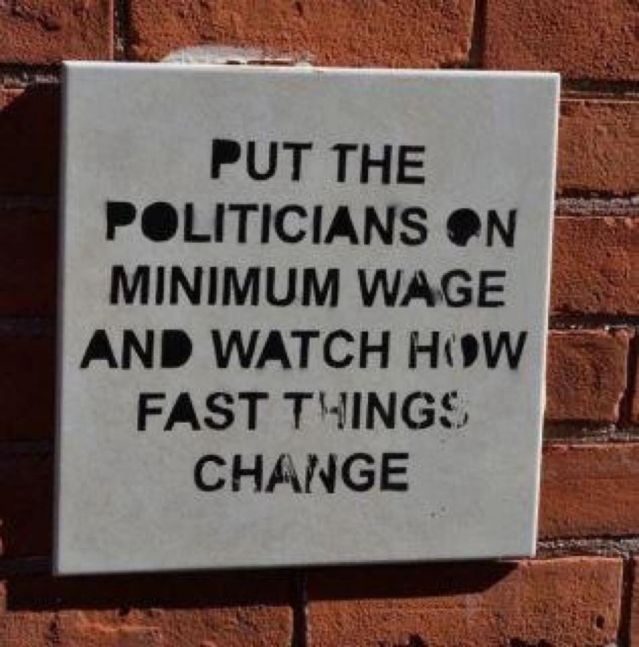
In this blog, I will be arguing and analyzing how increasing minimum wage can reduce suicide rates among the working class. The Global News article by Leslie Young details a case study showing the connection between increasing minimum wage and the decrease in suicide rates. The main argument being that “for every dollar added to the minimum wage suicide rates among people with high school education or less dropped by 3.4 to 5.9 per cent” (Young, 2020). In other words, increasing minimum wage and making it more of a living wage allows for people’s mental health to improve. As a result of their mental health improving, suicide rates decrease. Furthermore, Young mentions a quote from Evelyn Forget (Health Sciences Professor) who explains the lower someone’s income is the more likely they will suffer from anxiety and other mental health disorders (Young, 2020). In addition, it is also important to outline that this impacts people with a high school education or less because they are shown to be more impacted by the effects of minimum wage. This is because those with a college degree are less likely to work at lower wage jobs (Young, 2020). Moreover, research estimates that just a dollar increase in minimum wage could have prevented 27,550 suicides (Young, 2020). In particular with our recent minimum wage increases Canada’s suicide rate has decreased from 11.7 to 10.3 per 100,000 population (Young, 2020). Next, the case study also showed how increasing minimum wage is shown to provide a protective effect during times of unemployment. As well, Canada has more social policies that protect the unemployed compared to the U.S (Young, 2020). As well, for those who are employed cases have shown to they’re known to have greater job satisfaction which improves mental health (Leigh and Du, 2018). Since the workers are being paid more, they are more likely to be content with their job. When someone is content in their work life it can improve their mental health. This is because they aren’t suffering from job stress and the anxiety that comes from it. Job satisfaction benefits not only the workers but the employers. If an employee is satisfied with their job, they will most likely work harder and show better productivity. As well, hypothetically with the minimum wage increase it provides an economic incentive to work harder (Leigh and Du, 2018). Which some could argue could also damage mental health because of people pushing themselves to work too hard. However, there are policies in place that prevent working too many hours and are compensated for working overtime.
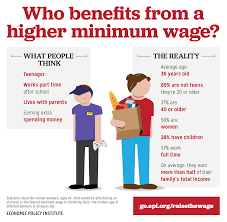
*Image above: Perception that minimum wage increase only benefits teenagers when in reality it improves the life of the working class that has kids and a family and work full time*
Lastly, by increasing the minimum wage by a couple dollars each period has been shown to not cause a significant raise in business costs (CMHA). Which many employers get concerned about when minimum wage skyrockets. When done efficiently minimum wage raise allows for closing the poverty gap and bettering mental health (CMHA). To conclude, with these case studies in mind politicians should consider both the mental health and economic effects when increasing minimum wage. The fact that all it takes is a raise in the minimum wage to decrease suicide rates and empower the working class should be proof politicians should continue to make it more livable wage. As argued throughout this post, there are many benefits mentally to the working class. However, this could also improve productivity which helps the employers with minimum business costs. Especially, in today’s society the prevention of suicide and the awareness of mental health are important. So, to have a policy in place that could decrease and prevent this issue should be valued and considered.

References:
Leigh, J. Paul. “Effects Of Minimum Wages On Population Health.” Effects Of Minimum Wages On Population Health | Health Affairs, 4 Oct. 2018, www.healthaffairs.org/do/10.1377/hpb20180622.107025/full/.
“Policy Papers on Equity.” CMHA Ontario, ontario.cmha.ca/documents/a-cmha-ontario-submission-to-the-minimum-wage-advisory-panel-a-healthy-approach-to-earned-income/.
Young, Leslie. “Increasing the Minimum Wage Can Reduce Suicide Rates, Study Finds.” Global News, Global News, 7 Jan. 2020, globalnews.ca/news/6377954/minimum-wage-suicide-rate/.
 Gelasia's workplace
Hi Gelasia,
I thought the article you chose related to commonly discussed topics in our society. Mental health is discussed in a wide variety of settings such as the workplace, schools, or sports teams. The article you summarized made some strong connections between increasing minimum wage and reducing suicide rates. I was not surprised to hear about this relationship because as you mentioned, mental health issues arise more often for individual’s with a lower salary. The prevalence of mental health in Canada is in any given year roughly 1 in 5 Canadians experience it some point in their life (Centre for Addiction and Mental Health). In addition, approximately 1 in every 2 Canadians has experienced some form of mental illness in their life (Centre for Addiction and Mental Health). These statistics demonstrate how major an issue mental health is in Canada. The main point of the article is to increase minimum wage, in addition to this effort what else do you think the government could do to reduce the prevalence of mental illness in Canada and address a major issue this country has?
References:
Mental Illness and Addiction: Facts and Statistics. (n.d.). Retrieved from https://www.camh.ca/en/driving-change/the-crisis-is-real/mental-health-statistics
LikeLike
Hello,
Yes I completely agree, mental health issues are definitely a huge issue in Canada. Especially based on the statistic mentioned that says 1 in every 2 Canadians experience mental illness at one point in their life. I also enjoyed this discussion question on what other efforts should the government put in place to address mental health issue. In terms of the workplace, I would say it would be nice for workplaces to set up insurance included with employment where workers can receive therapy. I know some of the reasons people don’t reach out and seek treatment is because therapy is expensive and not very accessible to people with an already low income. I know a few Starbucks locations has started this initiative and I feel it is something all workplaces and maybe even the government should consider as a mandatory measure. Perhaps, creating a mandatory work policy involving the coverage of mental health treatment to employees. In my opinion, making mental health treatment more accessible to lower-income people should be considered along with raising the minimum wage. As well, this could help even people of higher income who are struggling with mental health. For example, knowing that their workplace covers this type of treatment may de-stigmatize seeking treatment.
Thanks for your comment!
Gelasia Giff
LikeLike
Hi Gelasia,
I really enjoyed reading your blog post. I thought this article is very relatable to our society and life. It is not surprising that the suicide rates decrease and improve the mental health status when the minimum wage rises as how much money make generally increases the quality of life. It broadens people’s life choices and especially for the working classes this change is huge. This fact also reminds me of the thing I have learned in my previous EMPR course that raising wages helps to prevent demotivating workers. Although it does not help increasing productivity, it keeps employees satisfied which I believe relates to keeping them mentally healthy.
References;
Griffith, D. (2018). Conflict survival kit: tools for resolving conflict at work. Brantford, Ont.: W. Ross MacDonald School Resource Services Library.
LikeLike
Hello,
Thank you for reading the blog and commenting. I completely agree that the discussion of mental health is definitely relatable in present society and life. Now that our generation is more open to talking about mental health, we’re starting to realize ways in which we can improve it. To read that raising the minimum wage can not only prevent suicides but also improve the overall mental health of employees proves that the government should continue to raise it. You definitely brought up a point that I failed to mention which is that raising the minimum wage also broadens people’s life choices. As well, the point that this is a huge change that will improve the mental health of the working class. Knowing that the working class will have more jobs they can explore that have to pay them a certain wage (hopefully more livable in the future) can help with creativity and not feeling stuck in a job they hate. Which can sometimes contribute to depression when someone can’t work in a place that they enjoy for fear they won’t be paid right. Overall, raising minimum wage will have many great benefits on mental health and even the overall atmosphere of a work place.
Gelasia Giff
LikeLike